The 2026 Mascot Hall of Fame Ballot Has Everything:
NFL, MLB, NHL, College Sports and Banana Ball
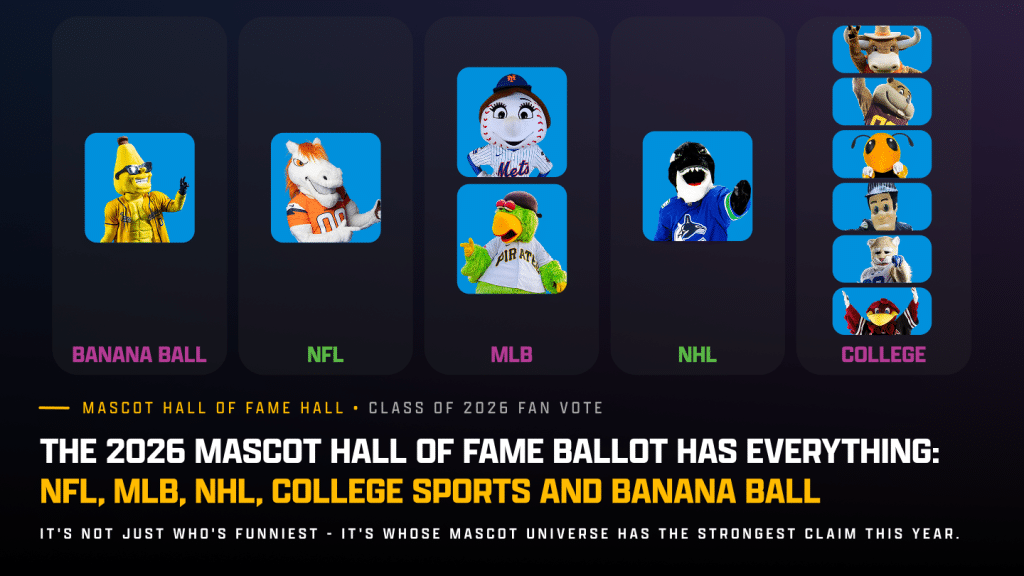
The Mascot Hall of Fame Class of 2026 ballot has everything: pro sports legends, college icons, hockey personality, NFL horsepower, baseball nostalgia, and one extremely shredded banana who seems to have wandered out of a gym commercial and into sports history. This is not just a vote. It is a mascot universe showdown.
The big question is not simply, “Which mascot is best?” That would be too easy, and possibly too dangerous to ask within earshot of a fan base. The better question is: which mascot world has the strongest claim this year — pro sports, college sports, or Banana Ball? The campaign notes frame this year’s race as a national sports and pop-culture story built around legacy characters, internet-famous newcomers, pro-sports nostalgia, college pride, and fan bases going head-to-head for mascot immortality.
Fans can vote online for the Mascot Hall of Fame Class of 2026, and this year, official nominee shirts count too. Every candidate shirt purchased through the MHOF Store counts as one vote for that mascot. One shirt. One vote. Unlimited team spirit. Mildly suspicious laundry-room campaigning.
TLDR; VOTE HERE
Banana Ball: Split and the New-School Entertainment Takeover
Let’s start with the yellow elephant in the room. Actually, not an elephant. A banana. A very tall banana.
Split of the Savannah Bananas represents the newest and strangest lane in this year’s race: Banana Ball, where baseball, comedy, choreography, trick plays, viral moments, and crowd participation all got tossed into a blender and came out wearing cleats. Split is known as the “World’s Strongest Banana,” which is not a normal job title, but here we are.
His case is built on modern sports entertainment. The Savannah Bananas have turned baseball into a traveling spectacle, and Split fits that universe perfectly. He dances, performs, flexes, creates social media moments, and looks like potassium finally got tired of being ignored by protein powder.
That gives Split a very different kind of Hall case. He does not carry the oldest tradition on the ballot, but he may represent where mascot entertainment is going. If mascots are now expected to dominate stadiums, short-form video, fan engagement, and “wait, did that banana just do that?” moments, Split is very much in the conversation.
NFL: Miles Brings Broncos Country to the Ballot
The NFL has one representative in this year’s vote, but Miles of the Denver Broncos is not exactly sneaking in quietly. He brings the full force of Broncos Country, Mile High energy, and a résumé that includes major moments in football.
Miles is tied tightly to Denver’s identity. The name itself works because Denver is the Mile High City, sitting at 5,280 feet above sea level. That makes “Miles” and “5280” more than a cute mascot pun. It is local branding with hooves.
His case also has depth beyond game day. Team-supplied notes credit Miles with hosting four AFC Championship Games, going to two Super Bowls, being part of the Super Bowl 50 win, performing in 10 countries and territories, visiting Children’s Hospital Colorado every month, and wearing Crocs, a company founded in Colorado. That is a lot of range for one horse. Frankly, the Crocs detail alone has big “Colorado character actor” energy.
The NFL lane is about scale. Football has massive crowds, intense fan loyalty, national reach, and a game-day environment where mascots have to compete with pyrotechnics, giant video boards, and people who paint their faces in freezing temperatures. Miles has spent years meeting that challenge with orange-and-blue enthusiasm.
MLB: Pirate Parrot and Mrs. Met Bring Baseball’s Long Memory
Baseball mascots have a special advantage in a race like this because baseball gives characters room to become part of the family. There are 81 regular-season home games, endless between-innings moments, community appearances, birthdays, school visits, T-shirt tosses, dugout dancing, and enough ballpark downtime for a mascot to build a whole personality arc.
This year, MLB brings two very different but very strong candidates: Pirate Parrot of the Pittsburgh Pirates and Mrs. Met of the New York Mets.
Pirate Parrot — Pittsburgh Pirates
Pirate Parrot has been bringing bright-green baseball chaos to Pittsburgh since 1979. That timing matters, too: 1979 was the year the Pirates won the World Series, giving the Parrot one of the better “hello, I have arrived” years a mascot could ask for.
His case is pure ballpark personality. Pirate Parrot is goofy, loud, colorful, instantly recognizable, and built for baseball’s unique rhythm. He can dance, joke, wave, rile up fans, and generally behave like a feathered agent of friendly disorder.
In the MLB mascot universe, Pirate Parrot represents the classic character entertainer. He is not just a logo with legs. He is a longtime part of Pirates fan culture, the kind of mascot fans remember from childhood and then introduce to their own kids years later. That is how a mascot goes from “fun at the game” to “part of the franchise memory.”
Mrs. Met — New York Mets
Mrs. Met brings one of the most meaningful historical cases on the entire ballot. Team-supplied details say she first appeared as Lady Met in 1965, connected to the Lady Met Club, a Mets fan community run by and for female fans from 1965 to 1997. Her official in-person debut came at Shea Stadium on Opening Day, April 8, 1975.
That gives Mrs. Met a Hall case bigger than a single team. She represents female fandom, women in sports, New York City, Mets history, and the staying power of a character who became far more than “Mr. Met’s counterpart.” She is a mascot with her own identity, her own following, and a very strong sense of how to work a room while looking Amazin’.
Her modern role keeps that legacy alive. Mrs. Met can be seen at home games dancing with the Queens Crew, throwing T-shirts, catching celebrity first pitches, giving high-fives and hugs, and generally proving that style and mascot stamina can coexist. Baseball’s lane is strong this year, and Mrs. Met is a huge reason why.
NHL: FIN the Whale Gives the Ballot a Splash of Canada
The NHL lane belongs to FIN the Whale of the Vancouver Canucks, and he gives this year’s ballot something important: international flavor. The Class of 2026 race is not only a U.S. sports story. Vancouver has an orca in the water, and Canucks fans have every reason to make noise.
FIN’s case is built around identity and fit. As an orca, he connects naturally to the Canucks’ visual history and British Columbia’s coastal character. Some mascots feel attached to a team. FIN feels like he swam directly out of the brand.
He also brings strong in-arena personality. FIN is known for big crowd interaction, playful antics, and whale-sized energy at Canucks games. Hockey mascots have to work in a fast, loud, cold, helmet-heavy environment where timing matters and the crowd can turn on a dime. FIN handles that world with big personality and a very useful ability to be both adorable and mildly alarming.
His lane may be the most underrated in the race. NFL and college fan bases can be loud. MLB nostalgia is powerful. Banana Ball is built for viral attention. But hockey fans are famously loyal, and Vancouver has a real chance to rally around the idea that Canada should have a whale in the Hall.
College Sports: Six Mascots, Six Fan Bases, Zero Chill
The college lane is absolutely loaded. Six of the eleven candidates come from college athletics: Hook ’Em, Goldy Gopher, Buzz, Cosmo the Cougar, Purdue Pete, and Cocky. That is not a category. That is a small, emotional weather system.
College mascots have a different kind of power. They are not just entertainment between plays. They are tied to campuses, alumni, student sections, fight songs, rivalry weekends, family traditions, and generations of fans who can identify a mascot silhouette faster than some relatives.
Hook ’Em — University of Texas
Hook ’Em brings the University of Texas into the race with one of the most recognizable identities in college athletics. The costume traces back to 1975, when Steven Sockler and art professor Hugh Head built the first head using a construction helmet and welding rods for the horns.
That origin story feels perfect for Texas: bold, practical, slightly dangerous-looking, and committed to the bit. Hook ’Em translates the famous Longhorns spirit into a live mascot presence, connecting one of college sports’ most famous hand signs with a character fans can rally around.
Hook ’Em also has big-stage credentials. Team-supplied notes say he traveled to Shanghai in 2015 for the Texas men’s basketball opener against Washington, the first regular-season game ever played in China. That is not just local pride. That is Longhorn spirit with a passport.
Goldy Gopher — University of Minnesota
Goldy Gopher is head-spinning, jittery, mischievous, and always smiling, which sounds less like a mascot description and more like someone after three stadium coffees. He has been representing the University of Minnesota since 1952, when members of the Pride of Minnesota Marching Band created the first gopher suit.
Goldy’s roots go back even further through Minnesota’s Gopher State identity. The state nickname came from an 1858 political cartoon that depicted Minnesota settlers as gophers, and the image eventually carried into University athletics. That gives Goldy a rare blend of school pride and state identity.
Performance-wise, Goldy is a powerhouse. He has won four UCA Mascot National Championships in 2011, 2013, 2017, and 2018. That means he brings not just tradition, but hardware. Some mascots smile for photos. Goldy smiles while casually stacking trophies.
Buzz — Georgia Tech Yellow Jackets
Buzz has one of the best “surprise entrance” stories on the ballot. His legend began in 1979, when a Georgia Tech student stormed onto the field during a pep rally wearing a Six Flags costume. Fans loved him, and a tradition took flight.
Buzz has since become a central part of Georgia Tech spirit. He is known for crowd surfing, the Buzz Flip, skits, high-energy appearances, and enough Yellow Jacket attitude to make opposing fans check for stingers.
His case is all about electricity. Buzz turns school spirit into motion. Some mascots wave. Buzz launches. Some mascots pose. Buzz flips. Some mascots walk into the room. Buzz arrives like someone ignored several reasonable safety briefings.
Cosmo the Cougar — Brigham Young University
Cosmo the Cougar may have the most acrobatic case on the ballot. He debuted in 1953, reportedly making his first appearance by parachuting into BYU’s football stadium. That is an entrance. Most mascots get introduced. Cosmo basically fell from the sky and said, “You’re welcome.”
Cosmo is known for elite athletic ability, viral dance routines, exciting game-day performances, and routines with the BYU Cougarettes that have reached audiences far beyond Provo. With more than 2.5 million social media followers, he is one of the clearest examples of a college mascot thriving in the modern era of virality.
His Guinness World Records make the case even stronger. Team-supplied notes credit him with records for most double high fives in one minute, most backward handsprings in one minute, and most consecutive breakdance windmills. That is less of a mascot résumé and more of a warning label.
Purdue Pete — Purdue University
Purdue Pete is one of the most unmistakable mascots in college sports. His origins go back to 1940, when University Book Store hired artist Art Evans to create a grinning, muscular boilermaker tradesman with a mallet and work hat.
Pete’s costumed debut came in 1956, and he has been staring directly into the soul of college athletics ever since. Early performers were expected to tumble with the cheerleaders while wearing a papier-mâché head and padding, which sounds like a training program designed by someone who disliked neck comfort.
His Hall case is built on tradition, intensity, and identity. Purdue Pete is not soft mascot energy. He is hard-hat, mallet-carrying, boiler-making energy. He represents a university, a nickname, a working-class visual identity, and a long history of fans who either love him, fear him, or both at the same time.
Cocky — University of South Carolina
Cocky brings one of the strongest championship résumés in the college lane. He won UCA Mascot Championships in 1986 and 1994, took the Capital One Mascot Challenge in 2004, and won another national title at the NCA Mascot Competition in Daytona in 2008.
That is a lot of trophy-case behavior. Cocky does not just show up with confidence. He has receipts.
In 2019, Sports Illustrated named him one of the 10 greatest mascots in college football history, according to team-supplied notes. That kind of recognition matters because Cocky’s case is not only about South Carolina pride. It is about decades of performance, personality, fan loyalty, and championship-level mascot presence. The name is Cocky, after all. Modesty was never really the brand strategy.
Which Mascot Universe Has the Strongest Case?
That depends on what kind of mascot greatness fans value most.
If the case is about new-school sports entertainment, Split and Banana Ball have a loud argument. He represents the viral, highly produced, social-first future of sports performance. Also, again: 7-foot banana with abs. This cannot be ignored as a development in modern athletics.
If the case is about pro sports reach, Miles, Pirate Parrot, Mrs. Met, and FIN bring major-league recognition. NFL, MLB, and NHL mascots live in massive entertainment ecosystems, and they have to connect with casual fans, diehards, kids, families, sponsors, and TV cameras all at once.
If the case is about history and fan memory, baseball has a particularly strong lane with Pirate Parrot and Mrs. Met. Ballparks give mascots decades to become part of summer, family photos, first games, and lifelong team identity.
If the case is about tradition and emotional intensity, college sports may be the heavyweight. Hook ’Em, Goldy, Buzz, Cosmo, Purdue Pete, and Cocky are not just mascots. They are campus symbols, alumni rallying points, rivalry-week fuel, and living shorthand for school pride.
The Real Winner Is the Debate
The best part of the Mascot Hall of Fame Class of 2026 vote is that there is no single kind of greatness on the ballot. This is not one lane. It is a pileup of mascot excellence, and somehow everyone is honking politely.
Split brings the future. Miles brings Broncos Country. Pirate Parrot brings baseball mischief. Mrs. Met brings history and representation. FIN brings Canada and hockey energy. Hook ’Em brings Texas tradition. Goldy brings championships and state pride. Buzz brings stunts. Cosmo brings records and viral reach. Purdue Pete brings old-school intensity. Cocky brings trophy-backed swagger.
So which mascot universe rules this year?
That is up to the fans. Vote online, vote twice a day, grab the shirt if you want to add another vote, and prepare your arguments. The road to mascot immortality is open, and this year’s field is gloriously ridiculous in all the right ways.
Eleven mascots. Three big worlds. One Hall of Fame dream.
Trivia note: Mascots were doing “viral content” long before social media had a name for it. Every dance break, crowd prank, pratfall, T-shirt toss, photobomb, and dramatic fake argument wi