Every FIFA World Cup Mascot Ranked, Roasted, and Celebrated — From Willie to the 2026 Trio
Sixty Years of Fuzzy Diplomacy, Bold Design, and at Least One Lion Who Started It All
The FIFA World Cup is the biggest sporting event on the planet. Every four years, billions of people tune in for the beautiful game — and somewhere in the middle of all that global drama, a cartoon character quietly shows up to represent the host nation, sell merchandise, and occasionally perplex the entire internet. Since 1966, every World Cup has had an official mascot, and the results have ranged from genuinely iconic to bafflingly abstract. As the world’s leading authority on mascots, the Mascot Hall of Fame is uniquely qualified to walk you through all of them — with full credit where it’s due and zero diplomatic immunity for the ones that missed the mark.
Buckle up. This is sixty years of World Cup mascot history, and we have opinions.
 The Pioneers: 1966–1978
World Cup Willie — 1966 (England)
The one that started it all. World Cup Willie is a lion wearing a Union Jack jersey with “WORLD CUP” written across the front — which is either the most on-brand thing England has ever done or a masterclass in not overthinking it. Either way, it worked. Willie became a genuine cultural phenomenon, spawning merchandise, a song, and a legacy as the mascot that proved mascots were worth having in the first place. World Cup Willie’s success made him a pioneer of mascots at major sporting events, setting the standard for his many successors.
Verdict: All-time great. The grandfather of the genre.
Juanito — 1970 (Mexico)
Following in Willie’s footsteps was Juanito, a boy decked out in a ‘Mexico 1970′ sombrero and the hosts’ famous green shirt. He provided a fittingly vibrant mascot for the first World Cup broadcast in color. Charming, simple, effective — Juanito is the mascot equivalent of a perfectly executed corner kick.
Verdict: Solid. Gets the job done.
Tip & Tap — 1974 (West Germany)
Two boys in matching white shirts — one reading “WM” (Weltmeisterschaft — German for World Cup) and the other “74.” Tip and Tap offered an image of togetherness and friendship. Efficient, tidy, and very German. Not exactly thrilling, but you wouldn’t expect West Germany in 1974 to send out anything other than a well-organized pair.
Verdict: Competent. Could have used more personality.
Gauchito Mundialito — 1978 (Argentina)
A young Argentine boy in traditional gaucho clothing, kicking a soccer ball with the confidence of someone who already knows his team is going to win. Which they did.
Verdict: Charming underdog who aged well.
 The Experimental Era: 1982–1994
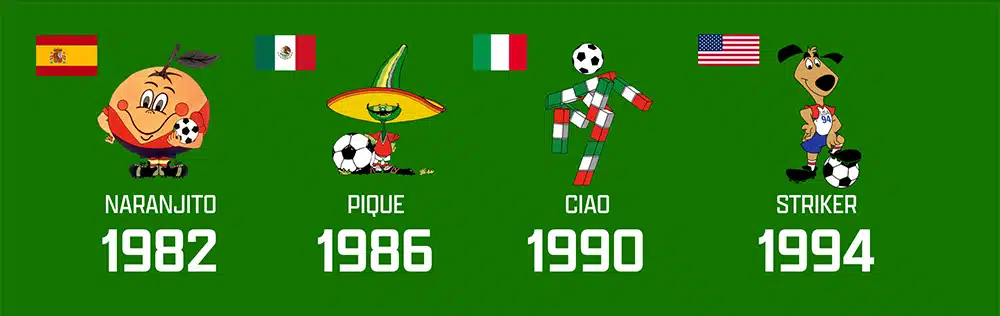
Naranjito — 1982 (Spain)
An orange. With a face. Wearing a soccer uniform. Spain sent an anthropomorphic piece of citrus fruit to represent them on the world stage and somehow made it work — Naranjito became one of the most beloved mascots of the era, beloved enough to anchor a full animated television series.
Verdict: Objectively absurd. Undeniably lovable. Hall of Fame energy.
Pique — 1986 (Mexico)
A jalapeño pepper with a sombrero and a mustache. Mexico doubled down on food-based character design and produced something that is either deeply charming or deeply unsettling depending on your relationship with spicy food.
Verdict: Bold choice. Respectable commitment.
Ciao — 1990 (Italy)
Here is where things get genuinely avant-garde. Perhaps the most avant-garde mascot in World Cup history, Ciao was a geometric stick figure assembled from colored blocks in the green, white, and red of the Italian flag, with a soccer ball for a head. No fur. No face. No warmth. Pure Italian modernism applied to a children’s character and somehow approved by an entire organizing committee. We respect the audacity enormously.
Verdict:
Absolutely unhinged. Historically significant. Only Italy could pull this off.
Striker — 1994 (USA)
America’s first World Cup produced a dog mascot named Striker — friendly, safe, and thoroughly inoffensive in a way that feels very 1994. He wore a USA jersey, smiled a lot, and represented a country still figuring out how it felt about soccer.
Verdict: Fine. America has since figured out how it feels about soccer.
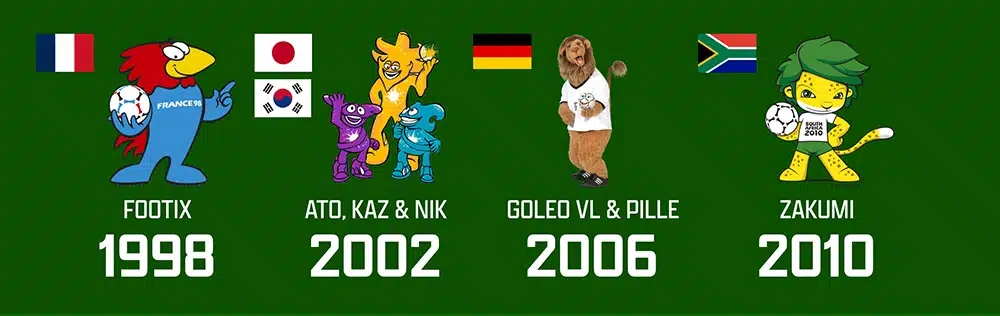
Footix — 1998 (France)
A rooster — the traditional symbol of France — rendered in bold blue with a red head and yellow beak. Footix’s bold blue body, red head, and bright yellow beak made him a colorful addition to a memorable tournament. France won the tournament on home soil, which retroactively makes Footix look like a genius.
Verdict: Great mascot. Great tournament. Great country to be a rooster in 1998.
Ato, Kaz & Nik — 2002 (South Korea/Japan)
The first World Cup of the new millennium brought the first trio of mascots in a predictably futuristic effort from the famously innovative co-hosts. Three alien-like “Spheriks” in purple, orange, and blue — futuristic, otherworldly, and designed for an era that was very excited about the internet. They haven’t aged as gracefully as Footix, but they were absolutely of their moment.
Verdict: Ambitious. Slightly terrifying in retrospect.
Goleo VI & Pille — 2006 (Germany)
A giant talking lion who wore a Germany jersey but — critically — no pants. His companion, Pille, was a talking soccer ball. Goleo VI was so poorly received that the company that produced the official merchandise went bankrupt before the tournament even started. He is, objectively, the most infamous mascot in World Cup history.
Verdict: A cautionary tale about pants.
Zakumi — 2010 (South Africa)
A leopard with green dreadlocks named Zakumi — derived from “ZA” (South Africa’s country code) and “kumi,” meaning ten in several African languages, marking the tournament’s host continent. Colorful, culturally grounded, and genuinely fun. World Cup mascots have become cultural touchstones that capture how each host nation sees itself. Zakumi captured South Africa beautifully.
Verdict: One of the best. Criminally underrated.
 The Recent Class: 2014–2022
Fuleco — 2014 (Brazil)
Brazil used a three-banded armadillo named Fuleco, an endangered species native to Brazil. These animals can curl into a ball when threatened, directly linking the creature to football, and the choice also carried a conservation message about protecting Brazil’s wildlife. The name combined futebol and ecologia, making it one of the most purposeful mascot names in the tournament’s history. Smart, purposeful, and genuinely cute. Verdict: Excellent concept. Excellent execution.
Zabivaka — 2018 (Russia)
A wolf whose name means “the one who scores” in Russian, Zabivaka was confident, stylish, and instantly likable. He wore sports goggles, a detail that FIFA described as giving him special targeting powers on the pitch. Chosen through a public vote, he became one of the most warmly received mascots in recent memory and a genuine cultural fixture of the tournament in Russia.
Verdict: Top five all-time. No notes.
La’eeb — 2022 (Qatar)
An abstract, ghostly figure inspired by the traditional Arab keffiyeh headscarf — flowing, ethereal, and unlike anything that had come before. La’eeb divided opinion sharply, with some finding him beautifully poetic and others genuinely unsure what they were looking at. In mascot terms, that’s not necessarily a bad thing.
Verdict: Polarizing. Culturally meaningful. Brave.
The 2026 Trio: Maple, Zayu & Clutch (Canada/Mexico/USA)
For the first time in men’s World Cup history, three mascots share the stage — one per host nation. Clutch is a bald eagle from the United States, playing as a midfielder, built around curiosity and optimism. Maple is a moose from Canada, a goalkeeper with a passion for urban art and music. Zayu is a jaguar from the jungles of southern Mexico. Together, they signal where World Cup mascots are headed: collaborative, character-driven, and deeply connected to both culture and digital life.
Three mascots for a 48-team tournament spanning three countries makes both logistical and creative sense — and all three designs are strong. Maple is immediately likable, Clutch has the star power of America’s most iconic bird, and Zayu brings genuine visual drama.
Verdict: The most ambitious mascot rollout in World Cup history. 2026 arrives with something to prove — and so do they.
Sixty years. Sixteen tournaments. Characters ranging from a pants-free lion to a geometric stick figure to a trio of animals representing an entire continent’s worth of football passion. What the FIFA World Cup mascot tradition proves, more than anything else, is that the beautiful game has always understood that sport is also storytelling — and every great story needs a face.
Some of these faces were timeless. Some were products of their era. And one of them really should have worn pants.
The Mascot Hall of Fame salutes them all — even Goleo VI.