The Wildest Lineages in Sports
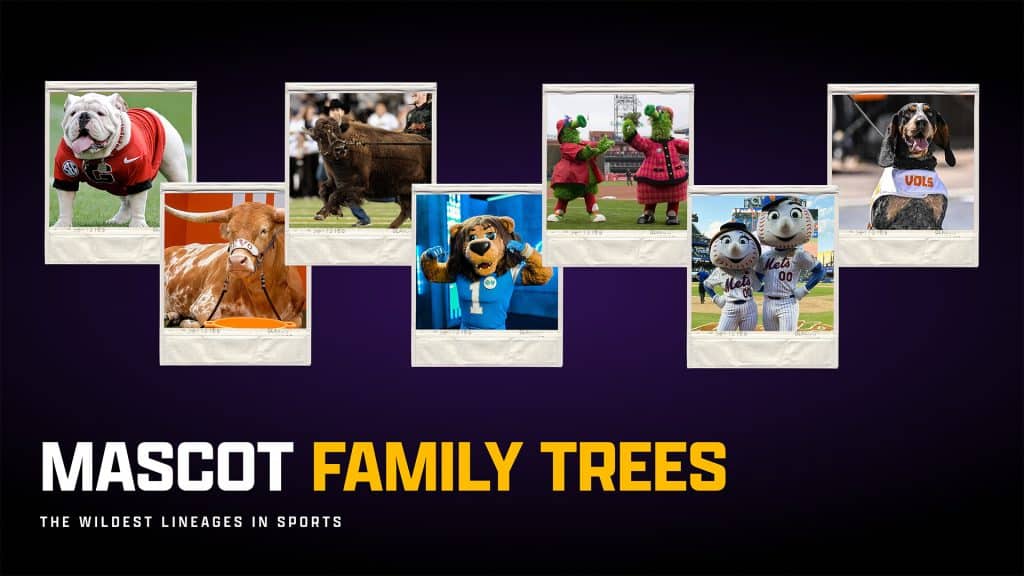
Some mascots are one-and-done characters. Others come from actual bloodlines, decades-long human family traditions, or full-blown mascot marriages complete with kids. Here’s a look at sports’ most surprisingly literal mascot family trees.
Uga: A Real Father-Son Dynasty (Georgia Bulldogs)
No mascot family tree is more literal than Uga, the University of Georgia’s line of pure white English bulldogs. Since Sonny Seiler introduced Uga I in 1956, every single Uga has been bred and owned by the Seiler family of Savannah. Every official Uga has come from the Seiler family’s line of white English bulldogs. Many successors have been direct descendants of the mascot before them, but the succession has included sons, grandsons, and even a half-brother.
The lineage is currently on Uga XI, nicknamed “Boom,” who inherited the title from his father, Que (Uga X), in 2023. Uga X retired as the winningest mascot in program history, with a 91-18 record and back-to-back national championships. When an Uga’s service ends, he is eventually laid to rest in the Uga mausoleum within the confines of Sanford Stadium. Bronze epitaphs mark the graves, and flowers are placed there before every home game. According to the University of Georgia, citing research published by The Pittsburgh Press, Georgia is the only major college that buries its mascots inside its stadium. (Source: University of Georgia Athletics; UGA Game Changers)
Bevo’s Line of Succession (Texas Longhorns)
Unlike Uga, Bevo isn’t a biological bloodline — each Texas Longhorn steer since Bevo I in 1916 has been individually selected, not bred from his predecessor. But the “family” framing still applies: 15 different steers have now carried the Bevo name across more than a century, each one inheriting the role, the burnt-orange branding, and the rivalry with Texas A&M that dates back to Bevo I himself.
Banquet Feast?
The Bevo tradition even carries one of college sports’ stranger rivalry stories. Texas A&M students branded the original Bevo “13-0” in 1917, commemorating their 1915 victory over Texas. Three years later, Bevo I was reportedly served as barbecue at a football banquet attended by representatives of both schools — and the Aggies were presented with the portion of his hide bearing their handiwork.
The current Bevo, Bevo XV, debuted in 2016 and is the largest live college mascot in the country. He’s had his own headline moment in the mascot world too — a widely publicized run-in with Uga at the 2019 Sugar Bowl, when Bevo charged toward Georgia’s mascot during a pregame meet-and-greet before order was restored. (Source: Dallas News; College Sports Network)
Ralphie’s All-Female Legacy (Colorado Buffaloes)
Colorado’s Ralphie tradition — bison sprinting across Folsom Field before kickoff — has run for decades years, currently on Ralphie VII. Like Bevo, the Ralphie lineage isn’t a blood family; each bison is individually selected (and always female) rather than descended from the last. Ralphie VII debuted September 20, 2025, against Wyoming. She was a one-year-old, roughly 700-pound American bison donated by the Beauprez family, owners of Eagle’s Wing Ranch near Steamboat Springs, after Ralphie VI showed diminishing enthusiasm for the game-day sprint and was sent to live out retirement alongside Ralphie V. She later received her nickname, Brandy, after the 1972 Looking Glass hit Brandy”(You’re a Fine Girl). That’s a fun little trivia nugget worth adding. Every retired Ralphie gets the same reward: a ranch and permission to finally stop running for a crowd. (Source: Fox News)
And yes: every Ralphie has been female. Colorado specifically states that females were chosen for their size and temperament; males can exceed 2,000 pounds and are considerably stronger.
The Human Family Behind Roary and Bubbles (Detroit Lions)
Not every mascot family tree belongs to the animal — sometimes it belongs to the people inside the costume. The Detroit Lions’ original mascot, Bubbles the Lion, was performed by four generations of the same family across more than 60 years before Roary took over the role in 2011. It’s one of the most under-the-radar mascot legacies in professional sports: an entire family quietly passing a costume down like an heirloom, decades before the modern “mascot performer” role became a formal, professionalized job. (Source: WXYZ Detroit)
The Phillie Phanatic’s Phamily Tree (Philadelphia Phillies)
The Phillie Phanatic didn’t merely arrive from the Galápagos Islands and start terrorizing umpires, opposing teams, and anyone foolish enough to leave popcorn unattended. Over the years, the Philadelphia Phillies built an actual fictional family around their green creation. The best-known relative is his mother, Phoebe Phanatic, who still makes special appearances at Citizens Bank Park, particularly for the Phanatic’s birthday and Mother’s Day.
Phoebe isn’t just a throwaway character mentioned in an old mascot biography. She’s a full-sized green Phanatic herself and has appeared with her son for decades; as recently as Mother’s Day 2026, the pair performed together during a Phillies game. The Phillies’ official Phanatic biography lists his birthplace as the Galápagos Islands and simply identifies his mom as “Phoebe,” making this one of the few major sports mascots whose official biography actually includes a parent.
The family tree gets stranger. The Phanatic also has a much smaller younger cousin named Phred, created as a baby-sized version of the Phanatic around the turn of the millennium. Original Phanatic performer and character developer Dave Raymond has explained that Phoebe, Phred, and the rest of the family grew out of the backstory the Phillies developed for the character after his 1978 debut.
And then there is Phiona, the Phanatic’s rarely seen girlfriend — which means Philadelphia mascot genealogy could theoretically get even more complicated someday. For now, however, the Phanatic remains one of sports’ most famous eligible green bachelors.
The Phillies have expanded his Galápagos connections beyond literal relatives, too. In 2015, they introduced the Galápagos Gang — Bessie the Blue-footed Booby, Calvin the Giant Tortoise, Sid the Sea Lion and Iggy the Iguana — as the Phanatic’s inflatable island friends and sidekicks. They aren’t technically part of the family tree, but they do give the Phanatic something few mascots can claim: a mother, a cousin, a girlfriend, a hometown and an entire ecosystem of friends.
Mr. & Mrs. Met: Baseball’s First Mascot Marriage
Mr. Met debuted as a cartoon in 1963 and became the first mascot in Major League Baseball history to appear in a live walk-around costume in 1964. Lady Met (later Mrs. Met) joined him in print form in 1965, becoming the face of the Mets’ Lady Met Club, a fan organization for women that ran from 1965 to 1997.
The two mascots were long depicted as a couple, occasionally appearing in print alongside three “little Mets” — cartoon children, the smallest shown as a baby in Lady Met’s arms. That family imagery became real in 2003, when Mr. Met, Mrs. Met, and their three kids appeared together in an ESPN SportsCenter commercial.
A note on dates: sources vary on exactly when Mr. and Mrs. Met “married” in the team’s official mythology — MLB.com’s own team history places Mrs. Met’s official in-person debut and marriage narrative in the mid-1970s (April 8, 1975), while other accounts cite different years. The real-life performers behind the characters were reportedly married in 1976 and stayed together 25 years. With Mrs. Met’s 2026 Hall of Fame induction alongside Mr. Met, the Mets became the first pro sports organization with two mascots enshrined in the Mascot Hall of Fame. (Source: MLB.com; Wikipedia)
Smokey (Tennessee Volunteers)
Tennessee’s Smokey tradition began in 1953, and for decades the succession really did involve a family line of Bluetick Coonhounds. That original bloodline eventually ended: Smokey X became the first mascot not descended from the original Smokey family. Then things came full circle when Smokey XI succeeded him — because Smokey XI was actually Smokey X’s biological son.
The family tree branched again in 2026. Current mascot Smokey XII, whose real name is Neyland, isn’t related to his predecessors at all. He’s a rescue Bluetick Coonhound discovered through East Tennessee’s rescue community and selected after UT’s mascot team evaluated his temperament and potential. In other words, Smokey’s family tree has included an original dynasty, a new bloodline, a genuine father-son succession and now an adopted newcomer — which arguably makes his lineage more interesting than a simple unbroken pedigree.