The Complete History of Mr. Clean
And the “Retirement” That Wasn’t
Few mascots have stayed this recognizable, this long, with this little change to the formula: bald head, gold earring, folded arms, white T-shirt. Mr. Clean has been the face of Procter & Gamble’s cleaning empire since 1958 — and in early 2026, he briefly convinced the entire internet he was walking away from it.
Here’s the real story, start to finish.
Where Mr. Clean Actually Came From
The product predates the mascot. In the 1950s, Linwood Burton, a businessman running a marine ship-cleaning company on the East Coast, needed a cleaner strong enough to cut through grease and grime on boat decks — without the harsh solvents that were injuring his workers and costing him in disability claims. Burton, who had a background in chemistry, formulated a solution that solved both problems. He sold the formula to Procter & Gamble in 1958. (Source: Wikipedia; Portable Press)
P&G had a strong product. What it needed next was a face.
Building the Character
In 1957, P&G brought the assignment to its advertising agency, Tatham-Laird & Kudner in Chicago. Harry Barnhart and Ernest C. Allen, working in the agency’s art department, are credited with conceiving the character — a bald, muscular man designed to visually communicate cleaning power. Commercial artist Fritz Siebel is credited with creating the first illustrated version of the character for print advertising. (Source: Wikipedia; Mascotpedia)
Sailor or genie? Procter & Gamble’s own official account has long stated that the visual inspiration for Mr. Clean was a U.S. Navy sailor from Pensacola, Florida. But the character’s folded arms, gold earring, and tendency to materialize at exactly the right moment have led many fans to read him as a genie instead — and at least one 1950s-era live-action commercial reportedly referred to him directly as one. Both explanations are widely repeated, and the true origin may be a blend of the two. (Source: Zinzin; House Digest)
The Debut
Mr. Clean’s original jingle was recorded in the summer or fall of 1957 in Chicago, written and produced by Thomas Scott Cadden. Procter & Gamble’s first batch of television commercials — nine one-minute spots and four shorter “lifts” — were produced in early 1958 and first aired in August 1958 on WDTV/KDKA in Pittsburgh, the same year the product launched nationally. The first actor to portray Mr. Clean in live-action commercials was House Peters Jr. (Source: Wikipedia)
The launch worked. Within six months, Mr. Clean was one of the best-selling household cleaners in the country.
Decades of Consistency
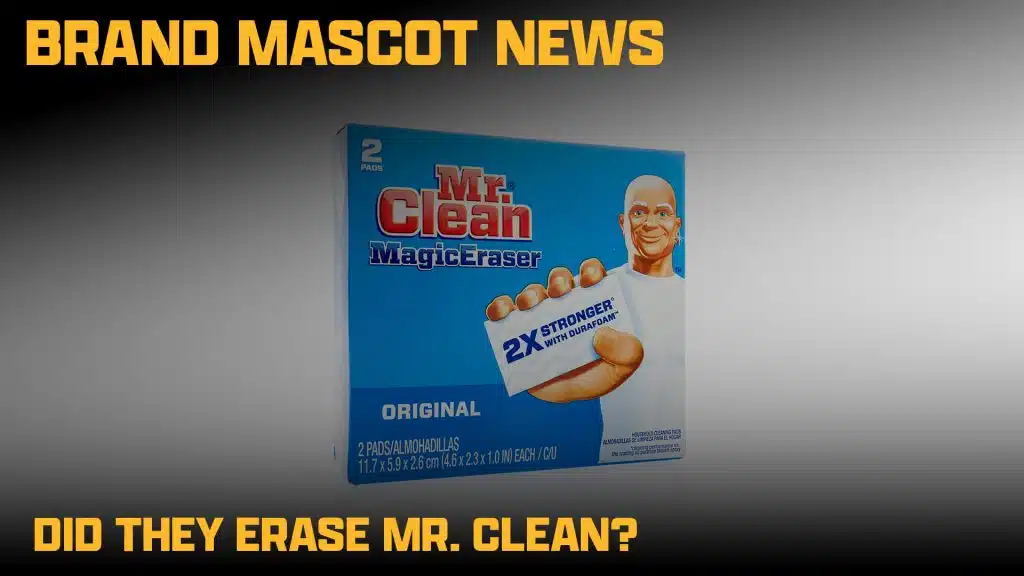
Mr. Clean’s look barely changed for nearly 70 years — a rarity in an industry where mascots are constantly refreshed, redesigned, or quietly retired. The brand expanded over the decades (the cleaner moved to plastic bottles in 1963, and the now-famous Magic Eraser line launched in the early 2000s), but the character himself stayed remarkably consistent: same bald head, same white shirt, same earring, same folded-arm confidence.
The “Retirement” (February 2026)
On February 19, 2026, Procter & Gamble posted an animated “news conference” on Mr. Clean’s Instagram account announcing his retirement. “The rumors are true!” the character said. “I’m retiring and saying goodbye to the world of cleaning to pursue new hobbies. You can call me Veritably now” — revealing, for the first time publicly, that his full name is Veritably Clean. (Source: CBS8)
The announcement leaned into an elaborate backstory: Mr. Clean was, per the campaign’s own mythology, “discovered as a baby with a remarkably shiny, bald head,” cleaning a farmer’s front steps, before growing up with a strong work ethic and eventually partnering with P&G.
Procter & Gamble was quick to clarify that, despite the retirement announcement, the products themselves weren’t going anywhere — no changes to packaging or the brand name were being made, and the company confirmed that more details would follow on March 4th. In the weeks that followed, Mr. Clean’s social accounts showed him “enjoying retirement” — DJing, cooking, competing in athletic events, and even touring a Zillow-listed Maui mansion positioned as his retirement home. (Source: KENS5; Marketing Dive)
The Comeback (March 4, 2026)
The “retirement” lasted exactly two weeks. On March 4, 2026, Mr. Clean officially un-retired — announcing new product innovations, including upgraded Magic Erasers and a new Mr. Clean Shower & Tub Scrubber.
“Legacies last forever, and Mr. Clean’s was nowhere near finished,” said Dave Landers, Vice President of North America Surface Care at Procter & Gamble. “We’re thrilled he’s back, because there’s a whole lot of magic in the new product lineup, and there is no one we’d rather partner with than the legend himself.” (Source: Barchart/Business Wire)
The entire retirement-and-return arc was, in the end, a coordinated marketing campaign — developed by PGOne (Publicis Groupe’s dedicated unit for P&G) and creative agency MSL — designed to generate media buzz and re-introduce Mr. Clean’s product lineup with a fresh news hook. By most measures, it worked: the retirement announcement drew real public reaction and press coverage, and the reveal generated a second wave of attention for the comeback and new products. (Source: Marketing Dive)
The Real Lesson
Mr. Clean’s 68-year run wasn’t actually interrupted at all — but the stunt says something honest about where mascot marketing is headed in 2026. Even a legacy icon with seven decades of brand equity needs a story arc now and then to stay culturally relevant. Fake retirements, staged comebacks, Notes App statements — the tools of celebrity PR have fully arrived in mascot marketing, and Mr. Clean just proved they work.
He never actually left. He just made everyone think he did.