Mascot Hall of Fame Trends
The Mascot Hall of Fame Class of 2026 nomination process is now underway, and that alone makes this a fun week in mascot history. The Hall’s home page is currently inviting fans and organizations to nominate mascots for the next class, which means the conversation is open again, even before any final list takes shape.
That also makes this a good time to look at a few trends in the Mascot Hall of Fame. Not because the Hall has a single rigid formula, but because its inductees, featured mascots, and milestone classes reveal patterns. Performance matters. Longevity matters. Identity matters. Influence matters. And sometimes the mascot that changed the game carries just as much weight as the one that remained beloved for decades.
Performance Still Sets the Standard
One of the clearest patterns in Mascot Hall of Fame history is the value of live performance. The mascots that leave the biggest mark are often the ones who command attention in real time: crowd work, skits, stunts, physical comedy, camera timing, and the ability to turn a break in the action into part of the show. That style has long been especially visible in basketball and other fast-paced entertainment environments, where mascots have to keep the energy high from start to finish.
The Hall’s own profile of YoUDee points directly to that performance culture. It highlights the University of Delaware mascot program as a pipeline for mascot talent and ties YoUDee’s legacy to performers who later shaped major-league mascot entertainment. That is a pretty strong clue about how the Hall views greatness. A mascot is not just a costume. It is a character brought to life through performance.
Baseball Mascots Still Carry Serious Weight
If one sport has produced some of the most recognizable mascot brands in America, it is baseball. The Hall’s home page currently spotlights Fredbird as a featured mascot, while its featured video references Hall legends, including the Phillie Phanatic and Mr. Met. Fredbird also appears in the Hall’s Class of 2025, which reinforces how powerful baseball mascots remain in Hall history.
That should not be a surprise. Baseball mascots have had decades to become part of the full ballpark ritual. They entertain between innings, connect with families, show up in community events, and grow into merchandising giants. Names like Phillie Phanatic, Mr. Met, Fredbird, Orbit, and Southpaw keep coming up because they have done more than represent teams. They have become lasting entertainment brands. In mascot terms, they are not just part of the game. They are part of the memory.
College Mascots Remain Deeply Rooted in Identity
Another clear trend at the Mascot Hall of Fame is the enduring strength of college mascots. In college sports, a mascot is rarely just an in-game entertainer. It is tied to campus tradition, alumni identity, school pride, fight songs, rivalries, and the emotional life of the institution. That deeper connection gives many college mascots unusual staying power.
The Hall’s recent classes reflect that clearly. Sebastian the Ibis appears in the Class of 2025, while Otto the Orange was inducted in the Class of 2023 and is described by the Hall as the first ACC mascot in the Hall. The Hall’s profile of YoUDee also underscores how one college mascot can carry both local identity and broader influence within the mascot world.
That is why names like Aubie, Brutus, YoUDee, Sebastian, and Smokey feel so important in mascot conversations. A great college mascot does not just entertain. It stands for a place, a tradition, and a shared history that can last for generations.
Pioneers Still Matter
Some mascots matter because they endured. Others matter because they changed the job for everyone who followed. That is why pioneer figures still cast such a long shadow over Hall conversations. The best example may be the Famous Chicken, which remains one of the clearest symbols of the modern era of mascot performance.
The point is not that every pioneer was literally first in line. The point is that some mascots transformed expectations. They proved a mascot could be funny, improvisational, memorable, and important enough that fans came to see that character as part of the attraction itself. Hall history tends to reward that kind of influence, because influence travels farther than novelty.
Hall History Shows There Is More Than One Path
One of the best things about the Hall is that it has never treated mascot greatness as a one-size-fits-all category. Its Class of 2023 included Slugger, described by the Hall as Minor League Baseball’s first Hall of Famer, right alongside Otto the Orange, the first ACC mascot in the Hall. That pairing says a lot about the Hall’s range.
It tells us that a mascot can stand out through national fame, performance excellence, deep tradition, or local impact. A powerhouse professional mascot may bring major recognition. A college mascot may evoke a sense of identity. A minor league mascot may embody pure fan connection and game-day joy. Hall-worthy greatness can wear different costumes.
Why the Class of 2026 Nomination Process Feels So Interesting
That is what makes the Class of 2026 nomination process exciting right now. The nomination stage is where possibility lives. Fans do not yet know what the full picture will look like, but the Hall’s history already shows the qualities that tend to matter most: influence, entertainment value, tradition, visibility, and connection to community.
This is also the stage when debate is at its healthiest. What counts most: performance, tradition, originality, cultural reach, or longevity? The answer, based on Hall history, is usually some combination of the above. The strongest mascot stories tend to live where those categories overlap. That is the sweet spot where a mascot stops being a sideline presence and starts becoming part of sports history.
What Hall History Suggests We Should Watch
As nominations for the Class of 2026 begin, a few themes are already worth watching. Will performance-heavy mascots continue to dominate the conversation? Will baseball’s brand power stay strong? Will college icons once again prove how much tradition matters? And will another trailblazer remind everyone that mascot history moves forward when one character redefines the role?
That is the fun of nomination season. Even before the names are finalized, the larger story is already in motion. The Hall’s own history shows that mascots can reach greatness in different ways, but the ones that last usually give fans more than laughs. They give them identity, memory, and a reason to keep watching.
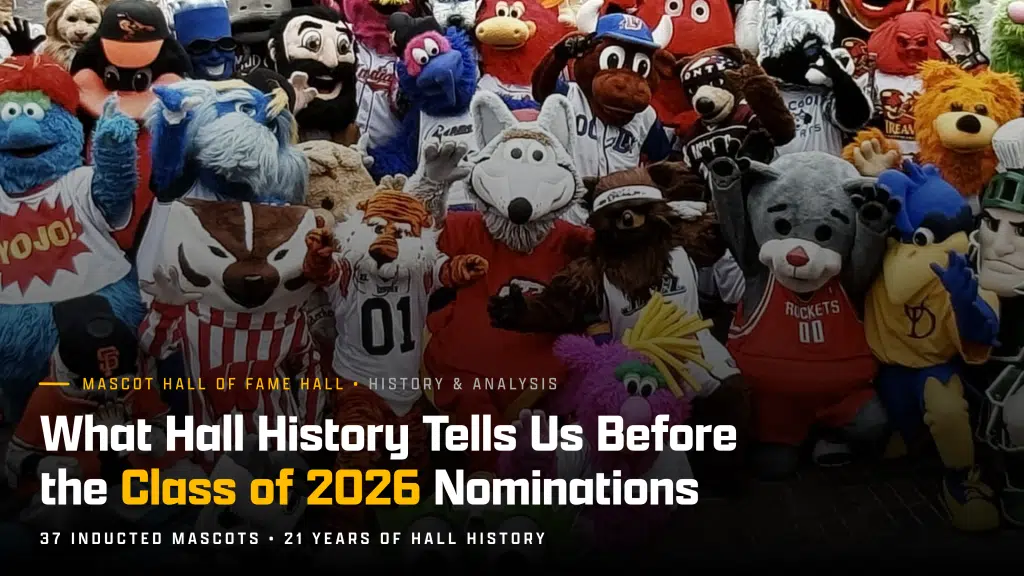
Trivia note: The Hall now has 37 mascots in the Hall and 21 years of inductions, with more to come, which is a nice reminder that mascot history is still being built one class at a time.